TL;DR
You can switch property management software without losing your data, but only if your reservation history, owner records, and financials are not locked inside a single system. The risk in a PMS migration is rarely the new software. It is that your data was only ever stored in one place, in one system's format, so moving it means re-mapping and re-syncing everything by hand. The way out is to keep a clean, portable copy of your data in a standard form that is yours to take, held separately from any one PMS. Do that, and changing PMS becomes a decision, not an ordeal. VIRTUENXT is built on exactly this principle: it runs on top of the PMS you already use, and keeps a portable copy of your data through one connection, so you keep your system of record and your freedom to change it.
Premise
Most property managers stay on a PMS that does about 90% of the job, because the thought of moving to another one is worse than living with the gaps. This guide explains why a PMS change feels so risky, what actually causes the data loss and downtime operators fear, and how to set your operation up so that switching, or simply adding the capabilities your PMS is missing, stops being a project you dread. After reading it you will be able to evaluate any tool, including your PMS, on whether your data stays yours.
Why "just switch" is the hardest sentence in property management
Ask an operator running 100 units why they haven't moved off a PMS that frustrates them daily, and you will hear a version of the same answer: "I can't face the migration."
That answer is rational. A PMS migration touches almost everything the business runs on: reservations, owner accounting, channel connections, housekeeping schedules, maintenance records, guest data, and owner relationships. Done poorly, it can create booking gaps, damage owner trust, and set operations back by months. Industry migration guides are blunt about the stakes, and they are right to be.
So the market has settled into a quiet truce. Operators keep a PMS that handles most of what they need, and they build manual workarounds for the rest: a spreadsheet for owner settlements, a WhatsApp thread for guest questions, a drive-around for inspections. The PMS is not loved. It is tolerated, because the alternative feels worse.
This guide is about ending that truce on your terms. Not by telling you to rip out your PMS (you have heard that pitch, and you are right to distrust it), but by showing you how to make your data portable enough that your PMS stops being a cage and goes back to being a tool.
The real problem is not the software. It is where your data lives.
Here is the reframe that changes everything: the pain of switching a PMS is not caused by the new system. It is caused by the fact that, until the day you decide to move, your data has only ever lived in one place, in one system's private format.
When your reservation history, owner splits, financials, and property records exist only inside your current PMS, moving them means extracting them into whatever export that PMS allows, then re-mapping every field into the new system's structure, then re-syncing every listing to every channel. That is the multi-month data-mapping project operators describe. The failure point is almost never the destination. It is the extraction.
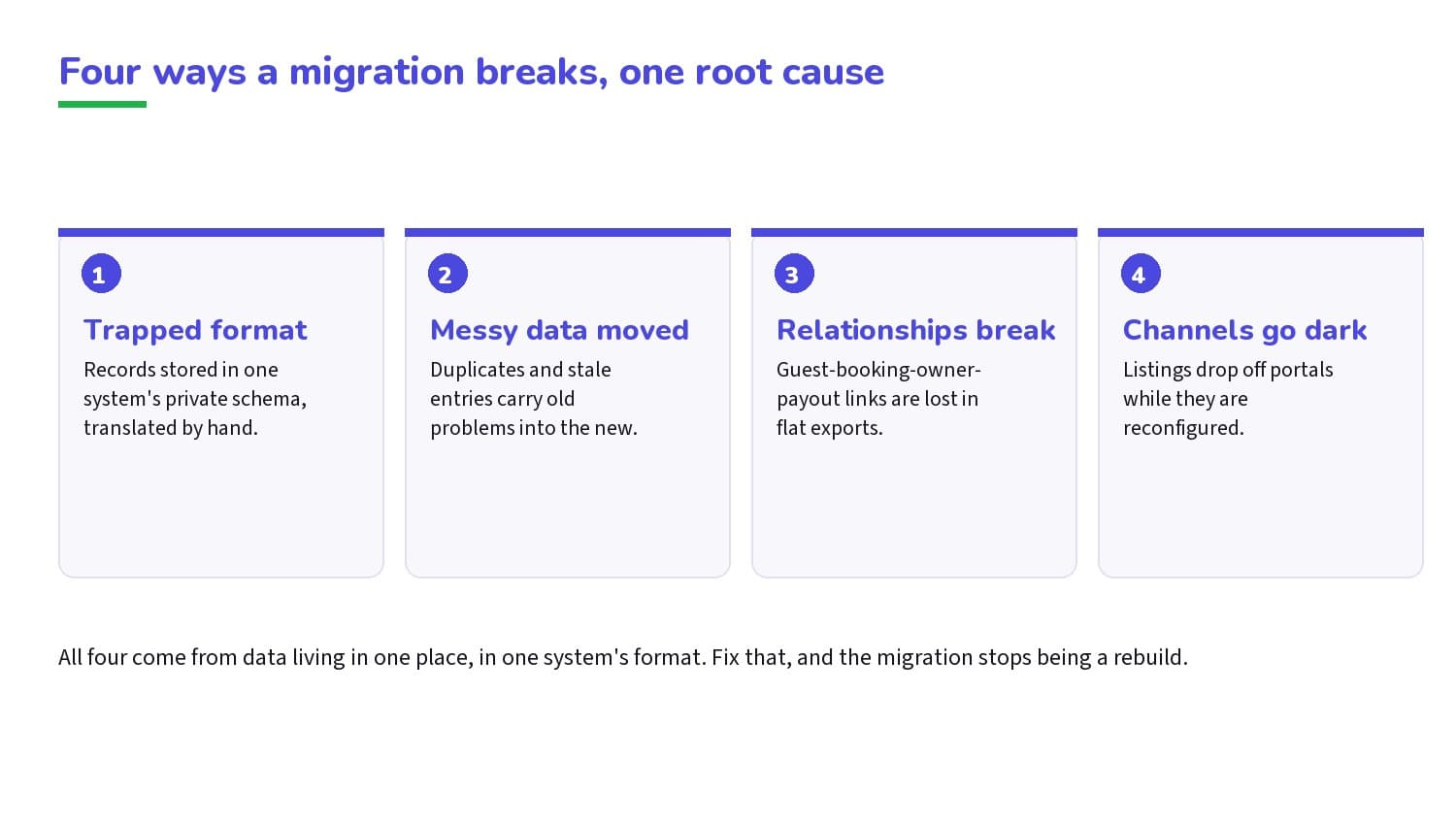
Most migrations that go wrong fail for one of these reasons, and none of them is really about the new software:
- Data was trapped in one format. The old system stored your records in a structure only it understood, so every field has to be translated by hand.
- Messy data got moved as-is. Years of inconsistent naming, duplicate owner records, and stale entries move straight into the new system, carrying old problems into a new space.
- Relationships between records broke. A reservation is linked to a guest, an owner, a unit, a rate, and a payout. Flat exports lose those links, so the finance team rebuilds them manually.
- Channel visibility went dark. While listings are reconfigured and re-synced, units can drop off the major portals, and a gap in visibility costs real booking momentum.
Notice what all four have in common. They are consequences of your data being stored in exactly one place, shaped for exactly one system. Fix that, and the migration stops being a rebuild.
What data portability actually means (and what it does not)
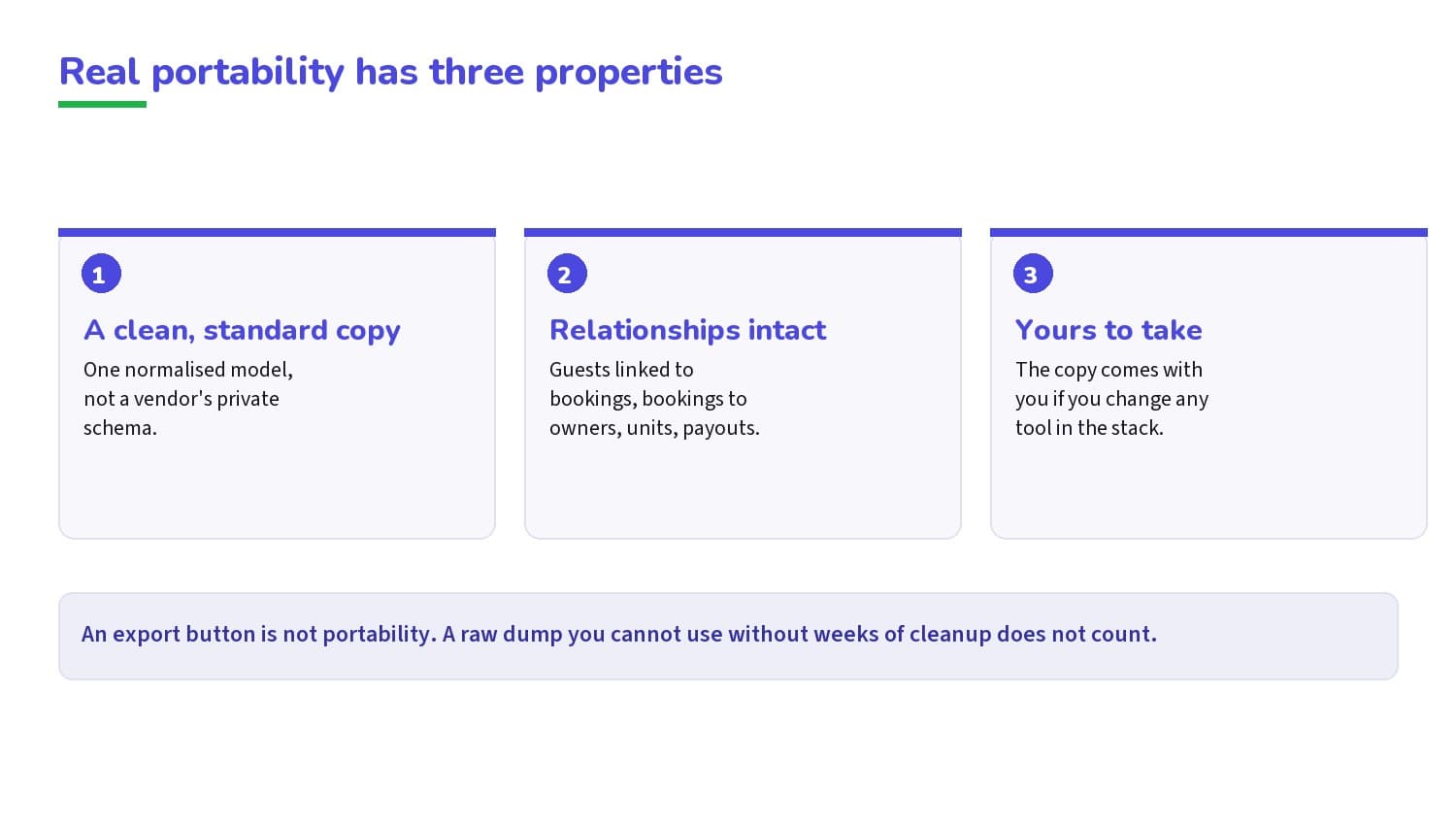
"Portability" gets used loosely, so let us be precise. Data portability does not mean your PMS has an export button. Every PMS has one, and an export is not portability if what comes out is a raw dump you cannot use without weeks of cleanup.
Real data portability has three properties:
- 1A clean, standard copy. Your data is held in a normalised model, one consistent structure, not the private schema of a single vendor. A reservation looks like a reservation regardless of which PMS it came from.
- 2The relationships are intact. Guests stay linked to bookings, bookings to owners and units, transactions to payouts. The connective tissue that makes the data usable survives.
- 3It is yours to take. The copy is not held hostage by a tool. If you change PMS, or change any other tool in your stack, the copy comes with you.
When those three things are true, switching a PMS is no longer a data project. It is a configuration change. Your history, your owners, your financial records, and your channel relationships already exist in a portable form, so the new system is populated from a copy you control rather than extracted painfully from a system you are leaving.
This is also the honest test to apply to any vendor, including your PMS and any tool you add on top of it. Not "does it integrate?" (everyone integrates), but "if I leave, does my data leave with me, clean and usable?" Most tools cannot answer that well. It is the question that separates a partner from a trap.
Keep the PMS you trust. Make your data portable anyway.
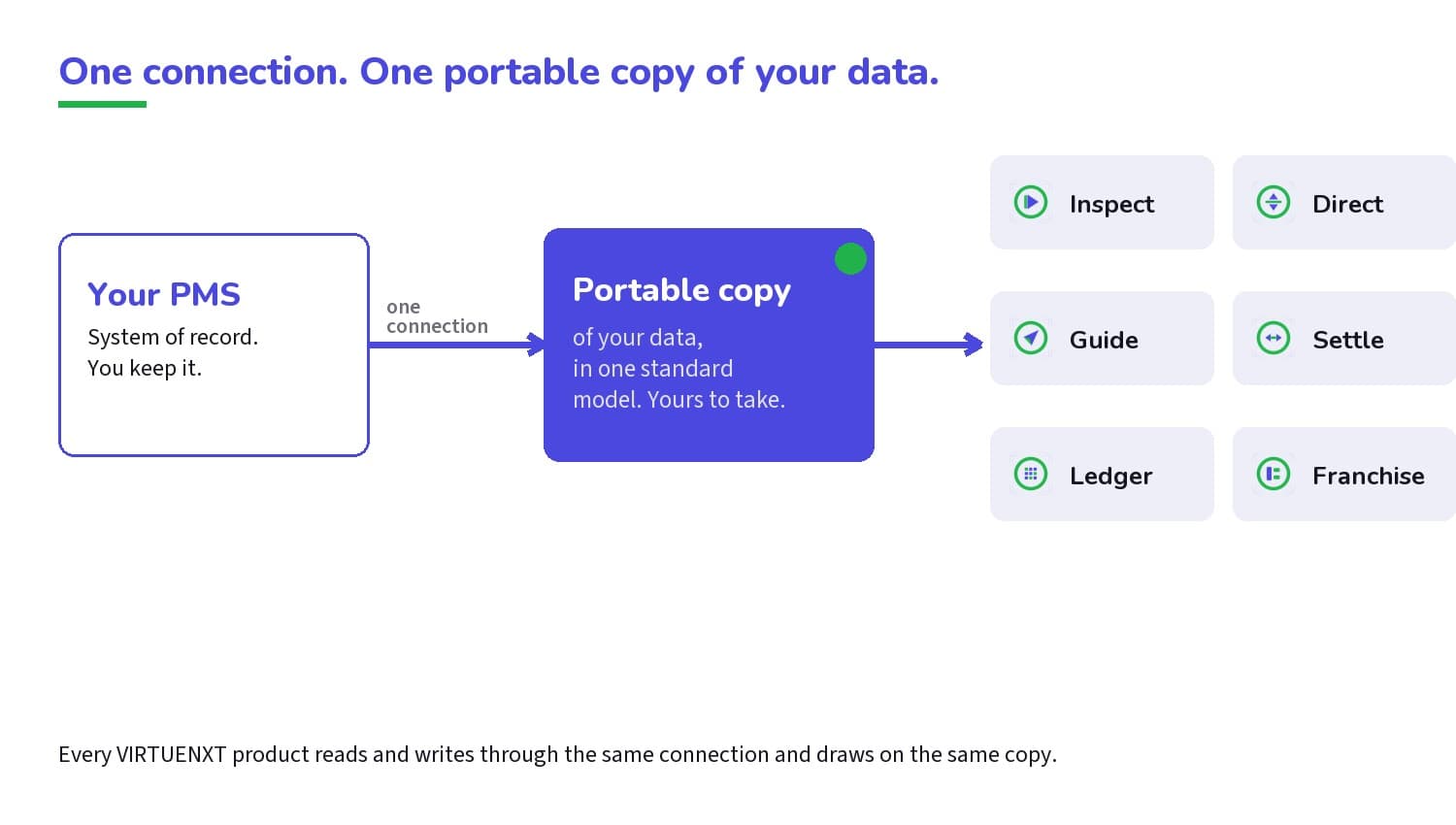
Here is the part operators find counterintuitive: you do not have to switch your PMS to solve the switching problem. You solve it by changing where a usable copy of your data lives.
You already chose a PMS. It works, mostly. You are not looking for a reason to choose another one. The goal is not to move off it, it is to stop being trapped on it, so that if the day comes when a better fit exists, or a market or a client forces a change, you are ready.
The way to do that is to add the capabilities your PMS is missing through tools that read and write to your PMS and, in the process, keep a clean, portable copy of your data in a standard form. Your PMS stays the system of record. A portable copy sits alongside it. You get the missing capability today, and the freedom to change tomorrow, from the same move.
This is the principle VIRTUENXT is built on. VIRTUENXT is a suite of hospitality products that run on top of the PMS an operator already uses, through a single real-time, two-way connection. Every product in the suite reads and writes through that one connection and stores your data in a single normalised model rather than locking it inside each separate tool. Your PMS keeps being the system of record. VIRTUENXT keeps the portable copy. That is what turns “switch anytime, keep everything” from a promise into something structural.
The adversary here was never your PMS. It is the point solution or all-in-one system that quietly makes itself the only place your data can live. A PMS you trust, plus a portable copy of your data you control, is a stronger position than a single system that does everything and owns everything.
A framework for evaluating your data-portability risk
Before you add another tool or consider any change, run your current setup through five questions. They map directly to where migrations break.
1. If you left your PMS tomorrow, in what form would your data come out?
A clean, structured export you could use, or a raw dump that needs weeks of interpretation? If you don't know, that is itself the answer, and it is a risk.
2. Do the relationships between your records survive an export?
Would guests stay linked to bookings, bookings to owners and units, transactions to payouts? Flat data that loses its links is the most expensive kind to rebuild.
3. How clean is the data you would be moving?
Duplicate owners, inconsistent naming, stale records. The messier it is, the more a migration multiplies the mess. Cleaning is cheaper before a move than during one.
4. Every time you add a tool, are you adding another silo?
Each point solution that connects separately to your PMS creates its own copy of your data in its own format. Five tools can mean five silos and five more things to untangle later.
5. Who owns the portable copy?
If the answer is "each vendor holds its own copy," you do not have portability. You have fragmentation. Portability means one clean copy, in a standard form, that you control.
If those questions make you uncomfortable, that discomfort is the real cost of the truce, the risk you carry quietly so you never have to face a migration. It is a cost you can remove without a rip-and-replace.
The compounding payoff: portability makes everything you add cheaper
There is a second benefit to keeping one portable copy of your data, and it is the one your budget holder will care about most.
With most tools, every new product you add is a fresh integration project: another connection to your PMS, another data mapping, another few weeks of setup and risk. Add four tools over two years and you have run four integration projects and created four data silos.
When your tools share one connection and one normalised copy of your data, that work happens once. The first product you add includes the connection to your PMS and the normalised copy of your data. The second product uses the same connection. So does the third and the fourth. The expensive, risky part, connecting to your stack and trusting the data, is already built and already paid for.
The result is simple math for anyone who owns the budget: each product you add costs less to adopt than the one before it. That is how VIRTUENXT is designed. You can start with a single product, whether that is real-time owner settlement, AI inspection, a direct booking engine, guest experience, or hospitality accounting, and add the next when you are ready, not when you can afford another integration. The connection is already there.
Portability and compounding economics are the same property viewed from two angles. One clean copy of your data, held in a standard form, is what lets you switch systems freely and add capability cheaply.
How to move from trapped to portable, without a migration
You do not need a big-bang project to get here. The practical path is incremental.
- Step 1: Audit where your data lives today. List every system that holds a copy of your operational data (your PMS, your accounting tool, spreadsheets, any point solutions). For each, note what format the data is in and how you would get it out. This is your portability map, and most operators have never drawn it.
- Step 2: Clean before you connect. Standardise owner and property naming, remove duplicate and stale records, and correct obvious errors. Clean data is cheaper to make portable and far cheaper to move.
- Step 3: Add capability through tools that keep a portable copy. When you add the next capability your PMS is missing, choose tools that read and write to your PMS and hold your data in a standard, portable form, rather than tools that create yet another isolated silo. You solve a problem today and reduce your switching risk at the same time.
- Step 4: Consolidate on one connection where you can. The fewer separate connections and copies you maintain, the lower your risk and the cheaper each future addition. A suite that shares one connection to your PMS does this by design.
- Step 5: Re-evaluate your PMS from a position of freedom. Once a clean, portable copy of your data exists outside any single tool, you can assess your PMS on its merits, not on your fear of leaving it. You may well keep it. The point is that keeping it becomes a choice.
Frequently asked questions
- How do I switch property management software without losing data?
- Switching without data loss depends on having your data in a clean, portable form before you move, not on the migration itself. The safest path is to keep a normalised copy of your reservations, owner records, and financials, with the relationships between them intact, held in a standard structure rather than locked inside one PMS. Then the new system is populated from a copy you control instead of extracted by hand from the system you are leaving. Audit where your data lives, clean it, and add tools that keep a portable copy, before you need to switch.
- Will I lose my data if I change PMS?
- You risk losing usable data, not the raw data itself. Most PMS platforms let you export, but a raw export can lose the links between records (guests to bookings, bookings to owners and payouts) and arrive in a format the new system does not understand. That is what makes migrations painful. If a clean, normalised copy of your data already exists outside the PMS, with relationships preserved, the risk drops sharply because you are working from a usable copy, not a raw dump.
- How long does a PMS migration take?
- It varies widely with portfolio size and data quality, and industry guides commonly describe it in weeks to months. The single biggest driver is not the new software, it is how clean and how portable your existing data is. Messy data stored in one system's private format takes far longer to move than clean data already held in a standard, portable structure. Reducing that risk in advance is the most effective way to shorten any future migration.
- What is the biggest risk in switching vacation rental software?
- The biggest risk is downtime and data fragmentation during the move: listings dropping off channels while they are reconfigured, broken links between records that finance has to rebuild, and owner trust taking a hit if statements are late or wrong during the transition. Every one of these traces back to data that lived in only one place, in one format. Keeping a portable copy of your data is the most direct way to reduce all of them.
- Do I have to replace my PMS to fix this?
- No. You can keep the PMS you already trust and still make your data portable, by adding capabilities through tools that run on top of your PMS and hold a clean, portable copy of your data. You keep your system of record and gain the freedom to change it later. This is the approach VIRTUENXT takes.
Next steps
The truce that keeps you on a PMS you have outgrown is not really about the software. It is about your data living in one place, in one format, so that leaving feels like starting over. Fix where your data lives, and the whole calculation changes: you can add the capabilities your PMS is missing today, and keep the freedom to change systems whenever it suits your business, not your vendor's.
VIRTUENXT is built for exactly this. It runs on top of the PMS you already use, adds the capabilities you are missing (AI inspection, direct booking, guest experience, real-time owner settlement, accounting, franchise oversight), and keeps a clean, portable copy of your data through one connection. Keep your system of record. Keep your data yours. Add capability without a rip-and-replace, and without a new integration project every time.
See how it would work on your stack. Request a demo.
VIRTUENXT is a suite of hospitality products engineered by JebiTech, a hospitality technology company building software for operators and the platforms they run on since 2017.