TL;DR
Physical inspection does not scale: a supervisor can only be in one place at a time, so as units grow, cleans get missed, damage is found by the next guest instead of your team, and disputes cannot be evidenced. The properties hardest to reach are the ones that go unchecked longest. The fix is to remove the travel constraint: guided capture so any staff member produces consistent, comparable inspection input, AI review so a person does not have to examine every image, a timestamped evidence trail so disputes are settled by record, and remote or drone capture for properties nobody can physically get to. VIRTUENXT Inspect is built on exactly this, so inspection stops depending on who can physically be where.
Premise
Inspection is the operational task that breaks first as a portfolio grows, because it does not scale the way the rest of the business does. This guide explains why physical inspection hits a wall, what happens to quality and disputes when it does, and how to keep every property inspected, including the ones nobody can easily reach, without adding headcount for every new unit. After reading it you will be able to design an inspection process that grows with your portfolio instead of buckling under it.
Why inspection breaks first as you grow
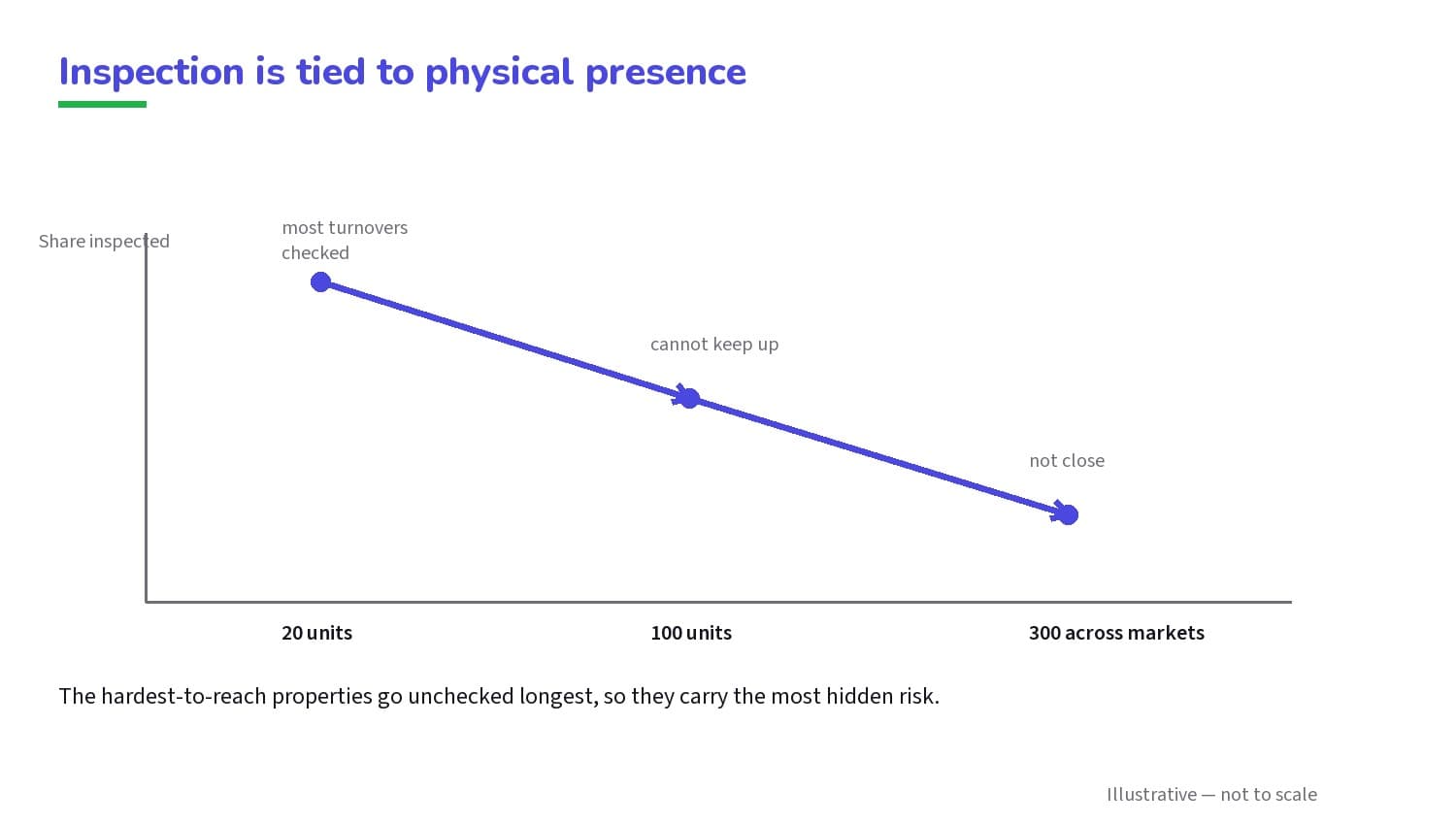
Most operational tasks scale reasonably well. You add units, you add a bit more of the systems and people you already have, and it holds. Inspection is different, because it has a hard physical constraint: someone has to be at the property, and a person can only be in one place at a time.
At 20 units, a diligent supervisor can physically check most turnovers. At 100, they cannot. At 300 across several markets, it is not even close. So what actually happens is that inspection quietly degrades from "every turnover, checked" to "the turnovers we could get to, checked, and the rest, hoped for." The degradation is invisible until it is not, and the ways it surfaces are all expensive:
- Cleans get missed. A turnover that was not inspected reaches the next guest with a problem the team did not catch, and the review score pays for it.
- Damage is found too late. Without an inspection after each stay, damage is discovered by the next guest or the next cleaner, by which point you cannot attribute it to who caused it.
- Disputes cannot be evidenced. When an owner or guest disputes damage, you need timestamped before-and-after evidence tied to a specific turnover. Manual, inconsistent photo threads rarely hold up.
- Quality drifts between properties and cleaners. Without a consistent, scored checklist applied everywhere, standards vary by who did the work, and the brand promise frays.
- The hardest-to-reach properties go unchecked longest. Remote units, upper elevations, and properties far from base are exactly the ones a supervisor cannot get to often, so they carry the most hidden risk.
The instinct is to solve this by adding inspection headcount for every cluster of new units. That works until the cost of it eats the margin the new units were supposed to add. The better answer is to remove the physical constraint itself.
The real bottleneck is travel, not effort
Notice what every failure above has in common: they are consequences of inspection depending on physical presence. The bottleneck is not that your team does not care or does not work hard. It is that quality control is tied to someone being physically at each property, and that does not scale.
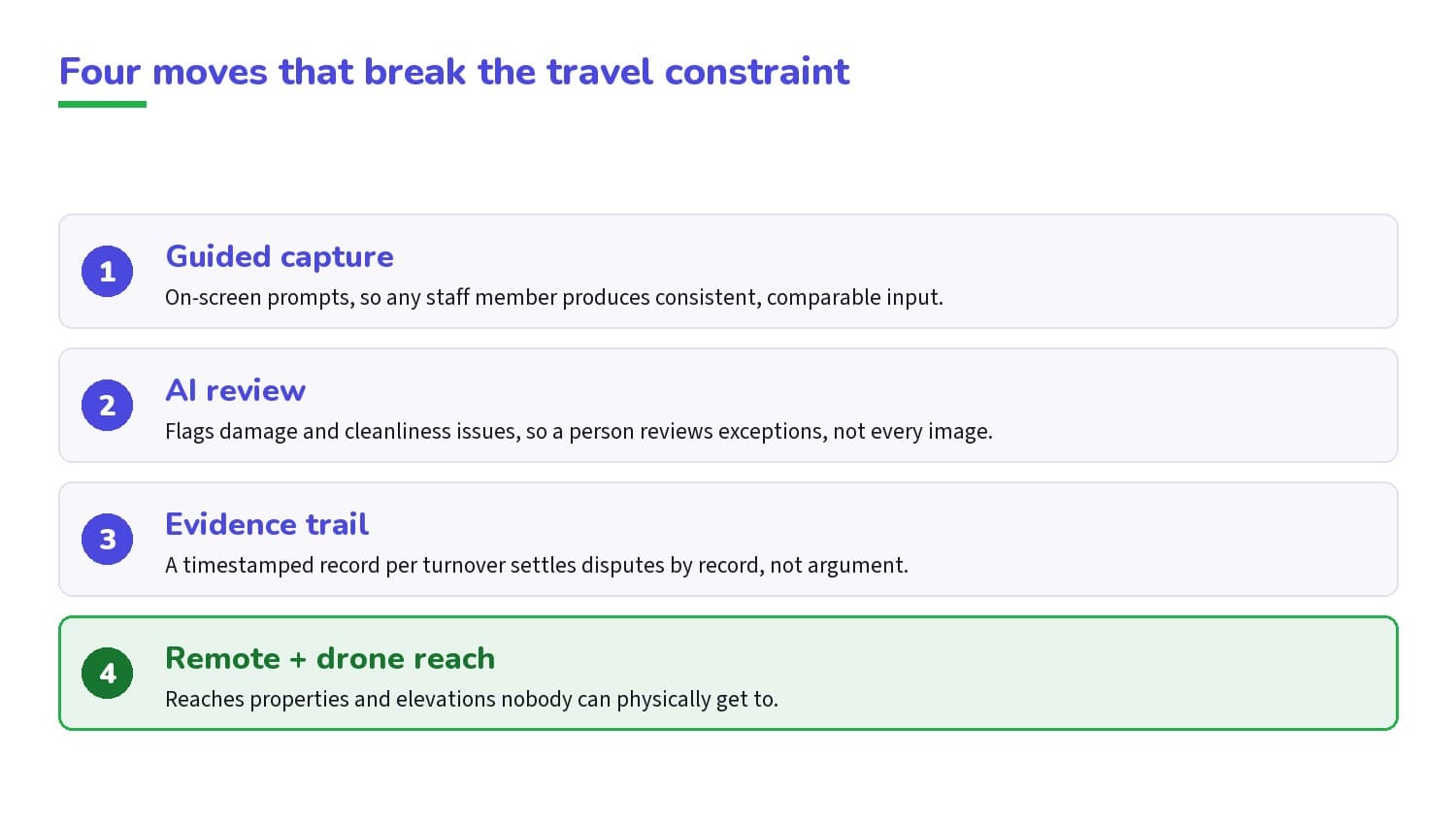
So the goal of a scalable inspection process is to break the link between "inspected" and "someone drove there." There are four moves that do it, and they build on each other.
1. Guided capture: make the input consistent, whoever captures it.
If inspection depends on a skilled supervisor's eye, it cannot scale, because you cannot clone the supervisor. Guided capture (on-screen prompts that tell whoever is on site exactly what to photograph and how) means any staff member or cleaner produces consistent, comparable input. This is the foundation: it standardises the raw material so the rest can be automated.
2. AI review: stop making a person look at everything.
Once capture is consistent, the review can be assisted. AI can flag damage, missing inventory, and cleanliness issues from the captured images, so a person reviews the exceptions rather than examining every photo of every turnover. This is what lets one person oversee inspection across a portfolio that no team could physically visit.
3. An evidence trail: settle disputes by record, not argument.
Every inspection should leave a timestamped visual record tied to the specific turnover. That record is what wins a dispute: a clear before-and-after, dated, that shows the state of the property at handover. This turns damage disputes from "your word against theirs" into "here is the record."
4. Remote and drone capture: reach what no one can get to.
For properties nobody can easily reach, remote units, or the parts of a property a ground-level walkthrough never covers such as outside elevations, drone capture sends imagery to the cloud for AI review. This is the move that closes the last and riskiest gap: the properties that currently go unchecked longest become the ones you can inspect without anyone traveling to them at all.
What a scalable inspection process looks like
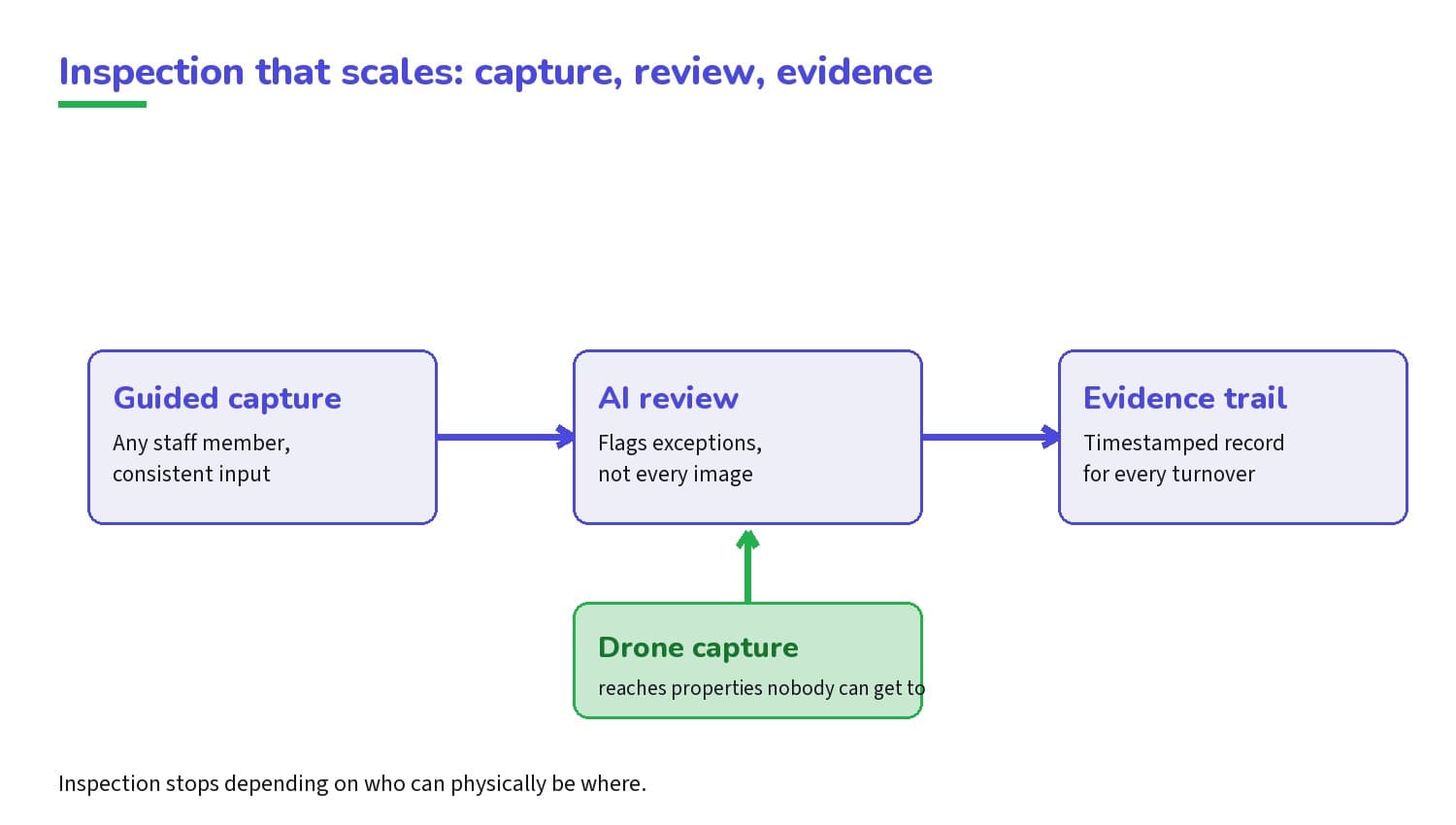
Put the four moves together and inspection changes character. It stops being a travel-limited task that degrades as you grow, and becomes a consistent process that covers every property regardless of where it is or who is available.
A cleaner or staff member on site follows guided prompts to capture each room and fixture the same way every time. For remote or hard-to-reach units, drone capture does the job no one can travel to. The AI reviews the captured imagery, flags damage, missing items, and cleanliness issues, and produces a scored result, so your team reviews exceptions instead of everything. Every inspection leaves a timestamped record you can show an owner or use in a dispute. Task management wraps around it: inspections are scheduled and assigned, issues become trackable tasks, and nothing depends on a supervisor happening to be nearby.
This is the design behind VIRTUENXT Inspect. It uses guided capture so any staff member produces consistent input, AI review so a person does not examine every image, a timestamped evidence trail for disputes, and drone capture to inspect properties and elevations nobody can physically reach. The result is the thing that breaks first as you grow, made to grow with you: inspection stops depending on who can physically be where.
(One deliberate note on claims: the value here is the capability, reaching and reviewing every property consistently, and the evidence trail, not a headline accuracy percentage. A capability you can demonstrate is worth more than a number you have to defend.)
A framework for assessing your inspection risk
Run your operation through these questions to find where inspection is quietly failing.
1. What share of turnovers actually get inspected?
Not scheduled, inspected. If you are honest and the number drops as the portfolio grows, that gap is your risk, and it is concentrated in your hardest-to-reach units.
2. Is your inspection input consistent, whoever captures it?
If inspection quality depends on which supervisor did it, it will not scale. Guided capture is what makes the input consistent across people.
3. Can you evidence a damage dispute with timestamped before-and-after records?
If your evidence is scattered photo threads, you will lose disputes you should win. A structured evidence trail is the fix.
4. Which properties go unchecked longest, and why?
It is almost always the remote and hard-to-reach ones. Those carry the most hidden risk precisely because presence-based inspection cannot reach them.
5. Does inspection cost scale linearly with units?
If every cluster of new units needs new inspection headcount, inspection is capping your growth. Breaking the travel constraint is what breaks that linear cost.
Frequently asked questions
- How do you inspect a vacation rental between guests?
- The scalable approach is guided capture (on-screen prompts telling whoever is on site exactly what to photograph), followed by review, ideally AI-assisted so a person checks exceptions rather than every image, with each inspection leaving a timestamped record. This produces consistent, comparable inspections regardless of who captures them, and creates the evidence trail you need if damage is disputed. It replaces relying on a supervisor to physically inspect every turnover, which does not scale.
- How do you scale property inspections across a growing portfolio?
- By removing the dependence on physical presence. Use guided capture so any staff member produces consistent input, AI review so one person can oversee inspections across properties no team could visit, a timestamped evidence trail for disputes, and remote or drone capture for properties nobody can easily reach. Together these break the link between "inspected" and "someone drove there," so inspection cost stops scaling linearly with unit count.
- Can you inspect a property remotely?
- Yes. Remote inspection uses captured imagery, including drone capture for properties or elevations nobody can physically reach, sent to the cloud for AI review. It is especially valuable for remote units and for the parts of a property a ground-level walkthrough never covers, such as outside elevations. Remote capture closes the gap on the properties that otherwise go unchecked longest.
- How often should you inspect a short-term rental?
- Best practice is an inspection at every turnover (after each guest, before the next), because that is what catches cleaning issues before a guest does and attributes damage to the correct stay. The obstacle is usually that inspecting every turnover physically does not scale, which is exactly why a capture-and-AI-review process matters: it makes every-turnover inspection feasible across a large portfolio.
- How do you prove guest damage in a vacation rental?
- With timestamped before-and-after evidence tied to a specific turnover: a clear record of the property's state at handover, dated, that shows the damage was not pre-existing. Scattered, undated photo threads rarely hold up. An inspection process that automatically produces a timestamped visual record for every turnover is what turns a dispute from an argument into a matter of record.
Next steps
Inspection is the first thing to break as a portfolio grows, because it is tied to physical presence and presence does not scale. Break that link, with consistent guided capture, AI review, a timestamped evidence trail, and remote reach for the properties nobody can get to, and inspection becomes a process that grows with you instead of capping your growth.
VIRTUENXT Inspect is built for exactly this: guided capture so any staff member produces consistent input, AI review so your team checks exceptions not everything, a timestamped record for every turnover, and drone capture for the properties and elevations no one can physically reach. It runs on top of the PMS you already use and keeps your data portable.
See how it would work across your portfolio. Request a demo.
VIRTUENXT is a suite of hospitality products engineered by JebiTech, a hospitality technology company building software for operators and the platforms they run on since 2017.
Related on VIRTUENXT